
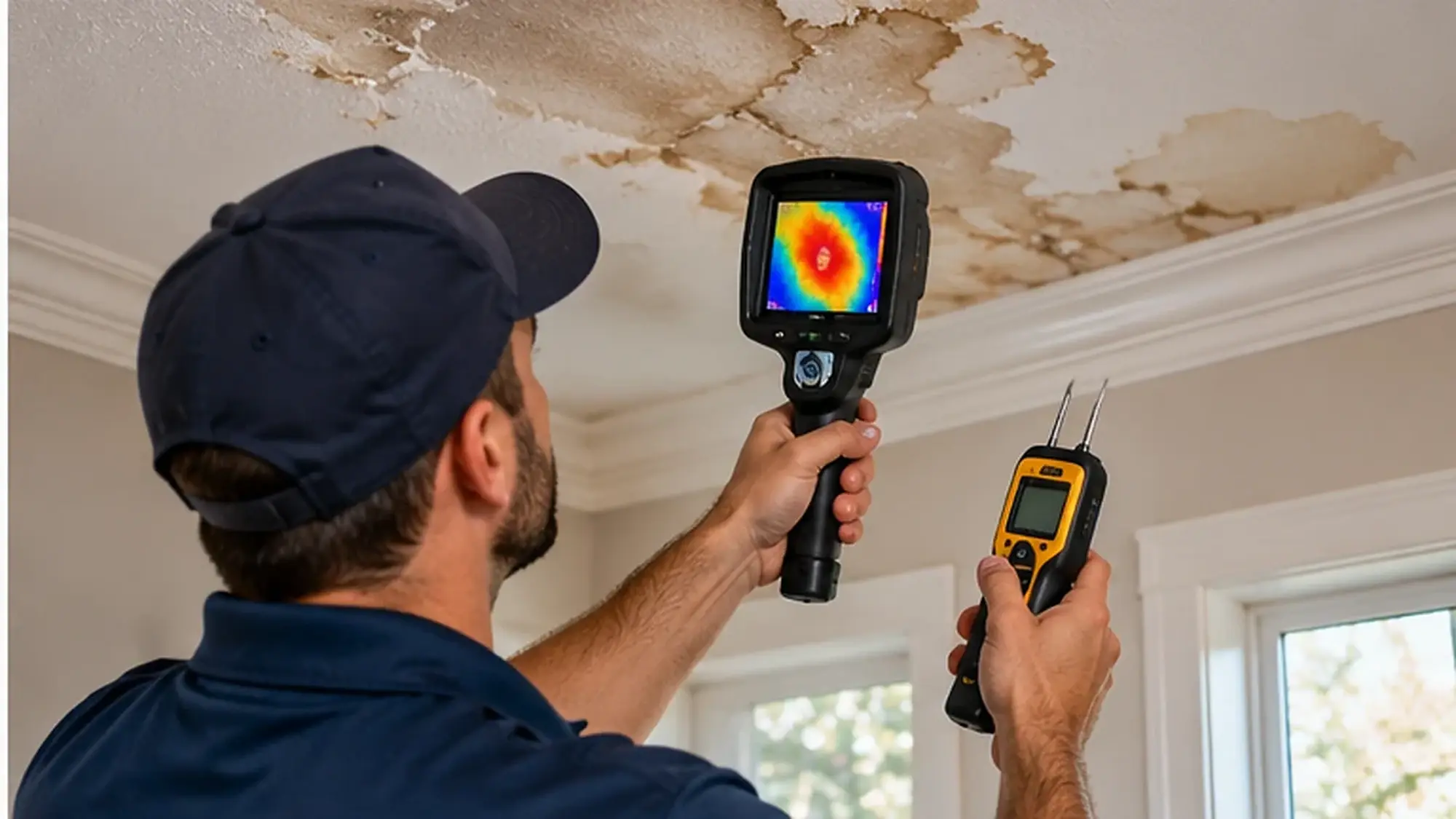
For properties around Crestview, the useful question after water enters is not only how much water is visible. The response should identify the source, map where moisture traveled and determine which materials need extraction, drying, cleaning or removal.
Water Damage Restoration in Crestview, DeSoto, TX: What the Job Involves
In Crestview, water damage restoration follows a fixed discipline: stop the source, extract the standing water, map moisture through flooring and wall bases, dry the structure against readings and document every step. Crestview is a DeSoto neighborhood, served from our base in the same city, so the response starts close and the assessment, not the visible puddle, sets what happens next.
The losses here are the DeSoto pattern at neighborhood scale: plumbing and appliance failures found late, condensate in summer, and storm water at doors and garages after heavy rain. Each behaves differently inside a house, which is why Crestview scopes are written per loss and per material instead of from a neighborhood template.
Why carpet and padding water damage deserves early attention
A water event can move into materials before the room looks severely affected. In Crestview, a homeowner may first notice a wet floor, a ceiling stain, a damp cabinet base, a carpet that feels heavier than normal or a musty odor. Those signs are useful clues, but they do not reveal the full moisture path by themselves.
Water can travel under flooring, into carpet padding, behind baseboards, inside cabinets and across adjacent rooms. A professional assessment should therefore look at the likely source and the building materials that could have absorbed water rather than relying only on visible staining.
What to do after a water event
- Stop or isolate the source when it is safe to do so.
- Keep away from wet electrical equipment and any water that may be contaminated.
- Photograph the condition and note the time and suspected source.
- Move safe, movable contents away from the affected area.
- Remove standing water when practical and appropriate.
- Check whether walls, flooring, cabinets or lower levels may have absorbed moisture.
Extraction and structural drying are different steps
Extraction removes standing or recoverable water. Structural drying addresses the water that remains inside materials and the surrounding air. Air movers can encourage evaporation, while dehumidification helps manage humidity so drying can continue. The plan should be monitored because different materials do not dry at the same rate.
A floor that looks dry can still have a wet pad or subfloor. A wall that has stopped staining can still contain elevated moisture. That is why repeated measurements can be more informative than appearance alone.
Local stormwater context
The City of DeSoto publishes drainage and stormwater information, including public planning around areas at risk of flooding. That municipal information can help residents understand broader drainage conditions, but private-property water damage still requires a property-specific assessment. During severe weather, follow official emergency guidance first and avoid moving water or electrical hazards.
When this local page should lead to a service page
If the main problem is a burst pipe, appliance leak, sewage backup, roof leak, flooded carpet, structural drying need or another defined loss, use the corresponding service page for deeper technical guidance. The site is intentionally organized so a customer can move from a local question to the service that matches the actual problem.
For water damage near Crestview, call +1 972-945-2324 with the source, affected room and any visible standing or contaminated water.
Call +1 972-945-2324Frequently asked questions
How quickly should water be removed in Crestview?
As quickly as it can be done safely, ideally the day the loss is found. Crestview homes sit on DeSoto's expansive clay, and water spreads under flooring and into wall bases past the visible edge. Same day extraction keeps materials dryable, and dryable materials are the difference between a drying scope and a removal scope on the claim.
How much does water damage restoration cost in Crestview?
Cost follows the scope: area wet, water category, how long materials stayed wet and what must be removed. A contained Crestview bathroom leak is a small job; water across several rooms is not. The figure that means anything follows a moisture assessment and an itemised written scope, which is also what your insurer will work from.
Does homeowners insurance cover water damage in Crestview?
For sudden, accidental losses, a burst pipe or a failed appliance for example, mitigation is commonly covered under Texas homeowners policies. Rising water and slow, neglected leaks are the usual exclusions. In Crestview, paperwork matters as much as the policy: dated photos, the repair invoice and a drying log turn a loss into a straightforward claim.
Do you offer 24/7 water extraction in Crestview?
Yes. Crestview is inside DeSoto, served around the clock from our base at 1603 Osprey Dr #11 in the same city. Call +1 972-945-2324 with the source, the rooms affected and whether water is still coming in. Those three facts plan the first visit at any hour, and they are the same questions every DeSoto neighborhood call starts with.
What does flood cleanup in Crestview involve?
Extraction of the standing water, removal of porous materials that cannot be sanitised, cleaning and treatment of hard surfaces, and structural drying verified by moisture readings. Storm water entering a Crestview home is treated as contaminated, because it crossed streets and yards to get there, and the work is documented from the first photograph.
Related water-damage services
Water losses often involve more than one problem. The links below connect this service with the adjacent restoration topics customers commonly need before or after extraction.
These public sources provide safety, flood, moisture and local infrastructure information. They are reference resources, not endorsements.
How the response can be staged around Crestview
For a local water loss, the work is easier to understand when it is broken into stages. First comes safety and source control. Next comes the assessment of where water traveled. Extraction removes recoverable standing water, but structural drying continues into the materials that absorbed moisture. Finally, cleaning, sanitation, documentation and any necessary reconstruction decisions can be handled according to the condition of the property.
That sequence matters because the visible condition can change quickly. A puddle can disappear while moisture remains in a carpet pad, under a floating floor, inside a cabinet box or behind a baseboard. Conversely, a visible stain can remain after the affected assembly has largely dried. Decisions should therefore be based on the source, material condition and measured progress rather than on appearance alone.
When a local problem becomes a bigger water-loss project
A small leak can become a larger project when it is left active, when moisture is trapped below the surface, or when contaminated water enters porous materials. The service pages on this site are intentionally separated so a homeowner can follow the problem from the local page to a specific solution such as burst-pipe removal, appliance-leak cleanup, structural drying, sewage cleanup, carpet extraction or roof-leak mitigation.