
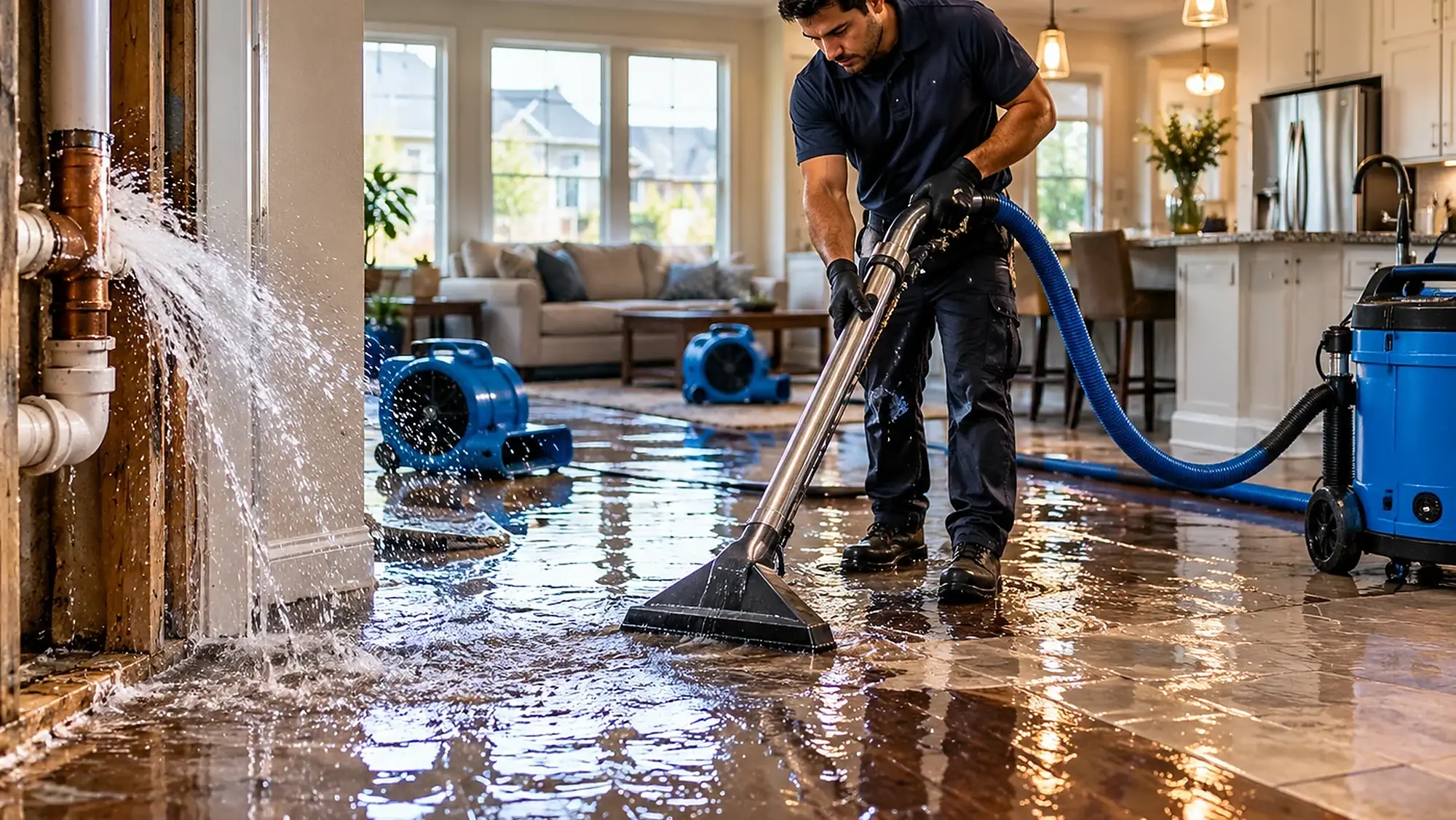
If water enters a home or business in Grand Prairie, begin with safety and source control when safe, then determine how far moisture moved into floors, walls, cabinets, contents and other materials. Creek-side streets and slab homes each change what that check looks like.
Water Damage Restoration in Grand Prairie, TX: What the Job Actually Involves
Water damage restoration in Grand Prairie, TX is property level work: stop the source, extract the water, map the moisture, dry the structure to verified readings and document the loss. Grand Prairie is one of the largest cities in this service area, spread across Dallas, Tarrant and Ellis counties, and it is served from our DeSoto base to the southeast. The city publishes its own water utility information for the municipal side. Inside the building line, the scope is the job described here, written for the specific property in front of us.
That property level focus matters in Grand Prairie because the housing stock spans generations. A 1960s ranch home near the original townsite, a 1990s subdivision in the city's center and a new build near Joe Pool Lake can sit in the same week of calls, and each one holds water differently. Older homes may hide galvanized plumbing and layered flooring; newer slab homes move water quietly along the slab edge into wall bases. The assessment, not the street address, decides the scope.
Common water-loss situations in the area
Most Grand Prairie calls fall into a short list: slab leaks in the city's large stock of slab-on-grade homes, supply line and water heater failures, appliance leaks that ran while nobody was home, roof leaks after North Texas storms, and creek corridor flooding along Johnson Creek and the low ground near Mountain Creek Lake. Each one is a different water category, a different spread pattern and a different drying plan, which is why the first visit is an assessment and not a guess.
Johnson Creek, Two Lakes and Three Counties: Grand Prairie's Water Map
Johnson Creek runs through the heart of Grand Prairie and is the city's known flash-flood corridor. In a hard rain the creek rises fast, and streets and low lots along its banks see water that homes a few blocks away never notice. Mountain Creek Lake borders the city on the east and Joe Pool Lake anchors the south, so storm runoff, high water tables near the shorelines and wind-driven rain off open water all shape the local loss pattern.
The practical lesson is that two Grand Prairie homes with the same square footage can face completely different water risks. A home on high ground near SH-161 worries mostly about its own plumbing. A home in the creek's drainage path adds rising water, mud and debris to the list, and a different insurance conversation, because rising flood water and plumbing water are not the same claim. Knowing which map your home sits on is step one of an honest restoration plan.
What a complete response should cover
A complete response covers five things in order: source control, so no new water enters the scope; extraction of standing water from floors, carpet and pad; moisture mapping that shows how far water actually traveled, including inside wall cavities; structural drying with air movement and dehumidification adjusted to readings; and verification, where final moisture numbers, not a calendar date, say the job is done. Skipping the mapping step is how a room that looks dry on the surface stays wet inside the wall.
Why hidden moisture deserves attention
Grand Prairie's expansive clay soils and slab construction make hidden moisture a real local issue. Water that reaches the slab edge can wick into wall bases and insulation and stay there long after the floor feels dry, feeding odor and mold growth behind paint. Moisture meters and, where needed, small inspection openings turn that guesswork into readings, and the readings decide whether a wall is dried in place or opened. It is slower than guessing, and it is the difference between a dry structure and a dry-looking one.
Grand Prairie public infrastructure reference
For the municipal side of a water problem, such as a suspected city line issue, a meter question or a boil notice, the City of Grand Prairie publishes water utility information through its official website, linked in the sidebar of this page. City crews handle the public supply up to the property line. The water inside your home or business, and the damage it leaves behind, is the private side of the line, and that is the work this page describes.
Related water-damage services
Every city page connects to the same service pages, because a Grand Prairie loss rarely respects category lines. The services most often involved are:
- Water Damage Restoration: the full process from assessment through verified drying.
- Burst Pipe Water Removal: extraction after a pipe failure, with the repair itself left to your plumber.
- Structural Drying: measured drying of walls, floors and framing.
- Storm and Flash Flood Water: response after weather-driven intrusion.
- Sewage Backup Cleanup: contained cleanup for category 3 losses.
- Mold Remediation: containment and removal when growth follows a loss.
- Commercial Water Damage Restoration: the same process planned around a business staying open.
Frequently asked questions
How much does water damage restoration cost in Grand Prairie, TX?
Cost depends on how much area is wet, the water category, how long materials stayed saturated, and whether drywall, flooring or cabinets must be removed and repaired. No honest price exists before the assessment. What you can compare is the written scope, the moisture readings behind it, and how completely the loss is documented.
How fast should water be removed from a Grand Prairie home?
As soon as it is safe to start. Extraction in the first day limits how far water spreads into walls and subfloors, and drying started early is what usually decides whether flooring and drywall can be saved. Every day of delay raises the mold risk and the repair scope, especially in slab homes.
Does homeowners insurance cover water damage in Grand Prairie?
Most Texas homeowners policies cover mitigation for sudden, accidental losses, like a burst pipe or an appliance failure, because fast extraction limits further damage. Rising water from Johnson Creek or the lakes is usually a separate flood policy question. Keep photos, readings and receipts either way; documentation decides how smoothly any claim moves.
What is the difference between creek flooding and a plumbing loss in Grand Prairie?
A plumbing loss starts inside the home, from a pipe, fixture or appliance, and is handled as a water damage claim with extraction and drying. Creek flooding is rising water from outside, it often carries soil and debris, and it is usually insured differently. The cleanup also differs, because outside floodwater is treated as contaminated.
Can mold grow after a water loss in a Grand Prairie home?
Yes, if materials stay wet. Mold can begin growing within one to two days on damp drywall, carpet pad and wood, which is why verified drying matters more than surface dryness. If growth is found, it is handled as its own remediation scope, with containment, after the moisture source has been stopped and dried.
Is there emergency water extraction near me in Grand Prairie?
Yes. Grand Prairie is served from the DeSoto base on Osprey Dr, west along I-20, around the clock. The response covers extraction, structural drying and moisture verification for homes and businesses across the city, from the Main Street core to the Joe Pool Lake side. Call +1 972-945-2324 whenever the loss happens.
What to Do in the First Hour of a Water Loss in Grand Prairie
First, protect people: keep clear of water near outlets, appliances and the breaker panel. Second, stop the source if you can do it safely, at the fixture valve or the home's main shutoff. Third, call +1 972-945-2324 and describe the source, the rooms affected and whether the water is still rising. Fourth, photograph everything before you move it, and lift contents, rugs and furniture legs out of standing water where that is easy and safe. Those four steps protect both the property and the claim.
Water Damage Repair in Grand Prairie TX: What a Complete Job Includes
Repair follows mitigation, and the two should not be confused. A complete job here means the structure is extracted, dried and verified, damaged materials that cannot be dried are removed cleanly, and the loss is documented well enough that the repair phase, whether handled by your contractor or ours, starts from facts: which rooms were wet, which materials were affected, and what the final readings were. That record is also what your insurer asks for, so it is built as the work happens, not reconstructed later.
Documentation That Protects a Grand Prairie Claim
Insurers pay claims they can verify. The file for a Grand Prairie loss should include dated photos before, during and after the work, moisture readings with locations, a list of affected materials and rooms, and notes on the source and when it was stopped. Keep receipts for anything you replaced and any city or plumber paperwork from the same event. Whether the loss is a slab leak in an older neighborhood or storm water near the creek, that documentation is what turns a stressful week into a payable claim.
Serving Grand Prairie From Our DeSoto Base
Grand Prairie is served from 1603 Osprey Dr #11 in DeSoto, southeast of the city via I-20 and I-35E. The same crew that answers the phone handles the extraction, returns for drying checks and closes the job with verification readings, for homes and for the offices, retail spaces and restaurants along the city's main corridors. One local team, one documented process, from the first call to the final numbers.