
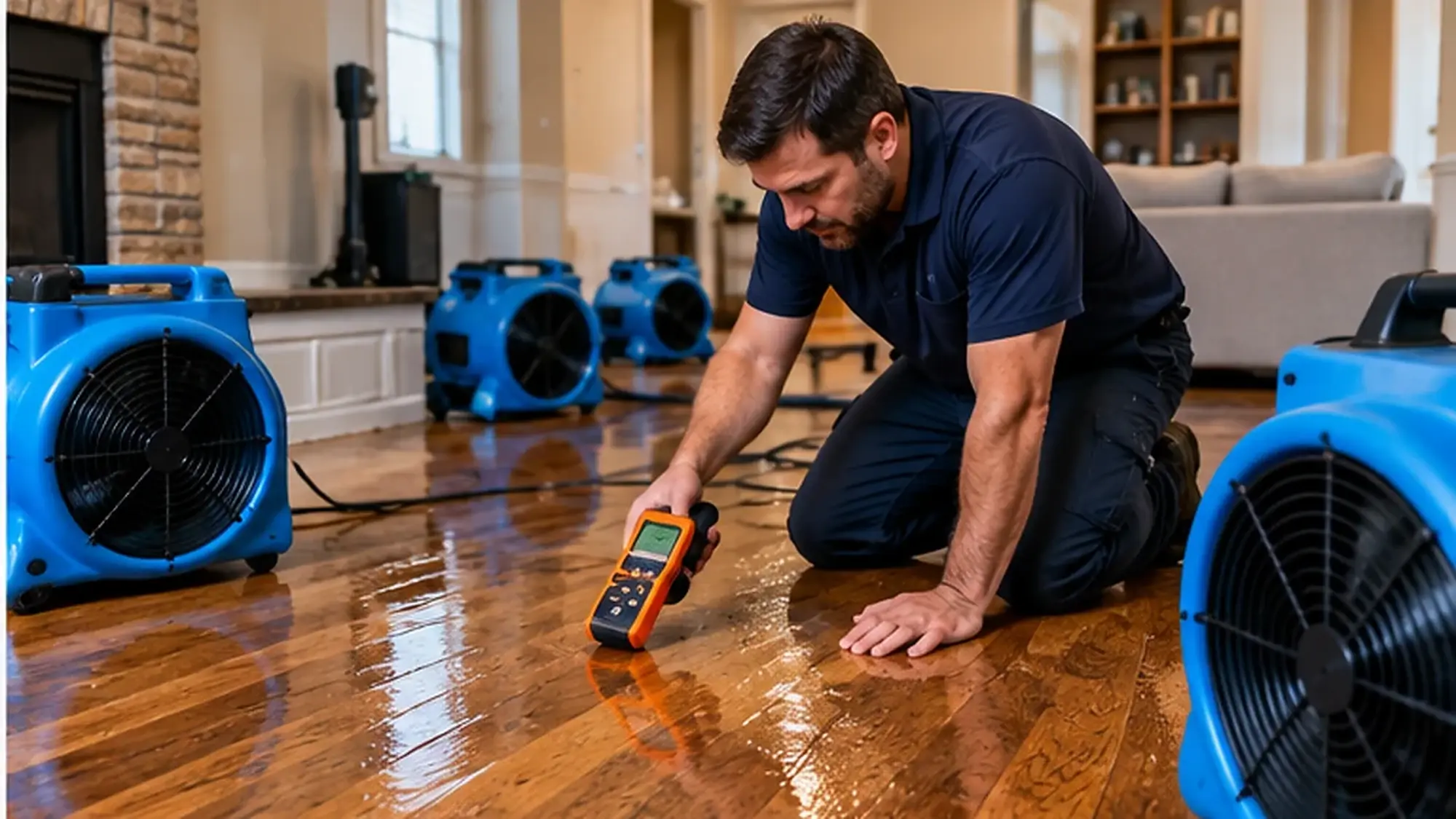
Wood responds to moisture by changing dimension. A wet floor can cup, crown, buckle or separate from the subfloor as moisture moves through the boards. That does not mean every wet hardwood floor is automatically lost. The more useful question is how much moisture entered the floor system and whether the assembly can be dried in a controlled way....
For local water-loss help in DeSoto, see Emergency Water Extraction in DeSoto TX.
Hardwood is a material problem, not just a surface problem
Wood responds to moisture by changing dimension. A wet floor can cup, crown, buckle or separate from the subfloor as moisture moves through the boards. That does not mean every wet hardwood floor is automatically lost. The more useful question is how much moisture entered the floor system and whether the assembly can be dried in a controlled way.
What changes the salvage decision
Water category, time in contact, board construction, finish condition, installation method and subfloor moisture all matter. Solid hardwood can behave differently from engineered wood. A floor installed over a wet subfloor may continue to change even after the visible surface improves. Decisions made from a quick visual inspection alone can therefore be premature.
Watch for cupping, buckling and edge swelling
Cupping is typically seen across the width of boards, while crowning is the opposite direction of movement. Buckling or tenting can indicate significant moisture and pressure in the assembly. Edge swelling can show that moisture reached the board ends or adjacent materials. These are clues, not a final salvage verdict.
Controlled drying matters
Drying a wood floor too aggressively can create a new problem by pulling moisture from one part of the board faster than another. The better approach is measured. Moisture readings from affected boards can be compared with unaffected wood in the same property, then drying conditions can be adjusted as the floor stabilizes.
For the service side, works alongside when the subfloor or adjacent assemblies are wet.
The subfloor can decide what happens next
A hardwood surface can look improved while the subfloor remains elevated in moisture. Depending on construction, water may also reach underlayment, sleepers or adjacent wall bases. That is why moisture mapping should extend beyond the visible boards when the loss was large enough to migrate through the assembly.
When replacement becomes more likely
Severe distortion, delamination in engineered flooring, prolonged contamination, loss of structural integrity, or materials that cannot be safely dried may move the decision toward removal. Even then, it is better to document why the material is unsalvageable than to default to replacement before inspection.
Documentation for a wood-floor loss
Photograph movement patterns, affected transitions and nearby contents. Keep notes about the source, duration and drying conditions. If a contractor provides moisture records, retain them with the loss documentation. A wood-floor project is easier to manage when the decision-making trail is visible.
The takeaway
Hardwood salvage is a measured process. Identify the water source, map the affected assembly, monitor moisture and control the drying rate. A floor that looks bad on day one is not necessarily a floor that must be discarded, and a floor that looks better on day three is not necessarily ready for refinishing.
Moisture movement inside wood flooring
Wood flooring does not absorb and release moisture uniformly. Board edges, ends, seams and the subfloor interface can respond differently from the center of a board. Changes in humidity can continue to affect the floor after the original water is gone, which is why monitoring matters during recovery.
Furniture and area rugs can also slow drying by restricting airflow. Where appropriate, these should be moved so the affected floor surface can be observed and the surrounding conditions can stabilize.
Refinishing is a later decision
A floor should not be refinished simply because it looks cleaner. Sanding or coating before the moisture condition stabilizes can lock in a problem or create a new failure. First confirm that the floor system has reached a stable, suitable condition; then decide whether cosmetic repair, board replacement or refinishing is appropriate.
This is particularly important where hardwood meets tile, carpet or laminate. The neighboring material may retain moisture even when the hardwood surface appears improved.
Different wood floors respond differently
Solid strip flooring, engineered planks and site-finished floors can respond differently to saturation. Finish condition, board width, installation method and the moisture level in the subfloor all influence the risk of further movement. Avoid treating every wood floor as if it has the same construction or the same salvage threshold.
Plan the recovery in stages
Initial extraction and stabilization are followed by controlled drying and monitoring. Cosmetic repairs come later. If boards are still changing shape, refinishing is premature. Where some boards are permanently damaged, selective replacement may be more appropriate than removing an otherwise serviceable floor.
Why patience is part of wood-floor restoration
Wood can continue to change after the visible water is removed. Humidity, subfloor moisture and the difference between board and underside conditions can influence how a floor behaves during recovery. That is why the best salvage decisions are often made after several readings rather than in the first visual inspection. Rushing to sand, coat or replace the floor can make it harder to distinguish original damage from damage caused by an overly aggressive repair approach. A controlled plan gives the material time to show whether it is stabilizing.
Common questions
Can hardwood floors be saved after water damage?
Sometimes. The decision depends on moisture, construction, timing, movement and subfloor condition.
Should hardwood be dried aggressively?
No. Controlled drying is important because rapid moisture loss can create additional movement.
Why check the subfloor?
The subfloor can retain moisture after the wood surface appears improved.
Call +1 972-945-2324 and describe the source, affected area and water type for next-step guidance.
Call +1 972-945-2324